El Pico
Radio Pirates Sail the World
November 2003
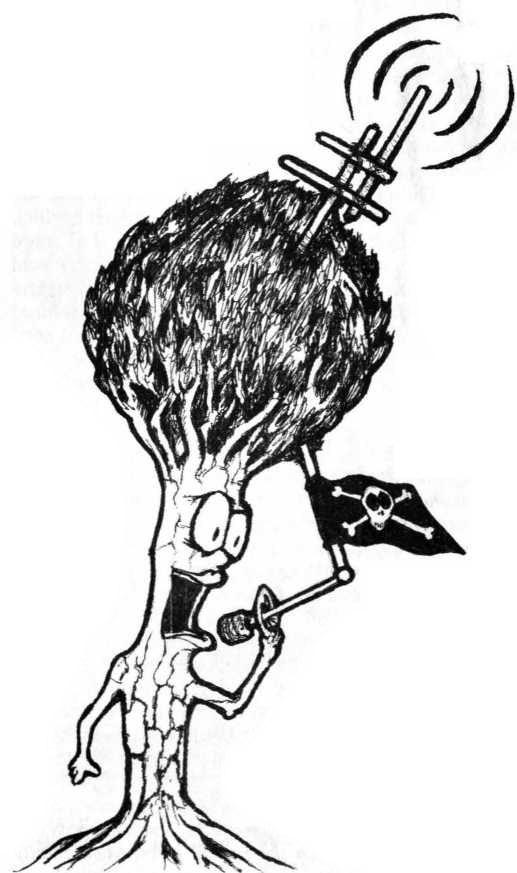
For a technologically enabled resident of a wealthy country, the work of creating and distributing alternative media can take numerous forms: print, video and web, to name a few. But for the five billion people living in a different economic reality, world news media generally originates from only one source: radio.
In places where daily newspapers have never been delivered, where television signals have never been received, where DSL, cable, phone or powerlines may never reach, short-wave radio signals bounce down from the ionosphere and become battery-powered news and music. Short-wave radio, also called world band, is the media that travels around the globe to every camp, village and town. It is heard daily by hundreds of millions of people.
So when an organization as hellbent on global domination as the World Trade Organization (WTO) met in Cancun, Mexico, in September, it seemed fitting that a voice of the people should be broadcast to the entire world. The dream was pirate radio, planetwide, via short wave.
Rigging the Topsail
Start 45 feet up a guy-wired fir pole. Follow the wire 200 feet over to the top of a tall ponderosa pine. Trace the thick, shielded feedline down through the oak canopy to the half-ton of salvaged industrial amplifier and then back to the modified amateur-radio transceiver. Inputs come from microphones, computers, compact discs and tape players. In the background, a 25-kilowatt generator cooking on biodiesel hums. Everything is grounded with six-foot-long copper rods firmly planted into Mother Earth. You are at the site of Radio Free Cascadia’s (RFC) latest and craziest attempt to operate behind enemy headlines.
RFC first went on the air in 1998 and is perhaps best known for its broadcast from high in a western hemlock in Washington’s Olympic National Forest during the Seattle round of WTO negotiations in November 1999. The FM signal—transmitted from station Y2WTKO—was heard throughout the Seattle metropolitan area during those five historic days of protest. When federal agents tracked the signal to the base of the hemlock, they endured a thorough taunting and left empty-handed.
Despite an impressive resume of actions in its five-year history, the jump from RFC to RFC-International was hardly guaranteed. But the theory made sense. With enough three-phase power, used equipment rewired for unimagined new purposes and a properly tuned, end-fire dipole antennae pointing toward Cancun, the signal would travel up out of Oregon, bounce off of the outer atmosphere and come down into Mexico. The hope was that any of the millions of short-wave radio listeners in Mexico could tune to 15045 KHz and hear a whole different story about the WTO.
Some great storytellers were ready to go. An Indigenous man from South America was onsite with an extensive collection of Indigenous and revolutionary music from the Americas and a strong understanding of globalization as it affects people on the ground. A Mexican woman and a woman from the US had agreed to provide correspondence from the streets of Cancun. A bilingual woman with years of Central American short-wave programming experience rounded out the principal on-air team. Half of the programming would be in Spanish and half in English.
When the switch was thrown, the first sign of non-disaster was the lack of smoke or fire coming from amp or wire. “Thank you for tuning to RFC-International, broadcasting from an organic farm in the mountains of Cascadia. We are broadcasting in solidarity with the people in the streets of Cancun. We modulate the air as freely as we breathe it, in opposition to those who seek to control it.”
Something positive seemed to be happening when speakers in a farmhouse nearby were found playing the program without turning the radio on! Good try, but not quite.
Measurements indicated that the system was throwing out a signal with strength above 8,000 watts—the largest AM stations in the US produce 50,000 watts. But was anyone listening?
Out went the live interviews from the streets during actions. Out went the latest news on the ever-failing negotiations. Out went programming on the repression of Indigenous people and people of color, as well as interviews with Starhawk and a local Latino labor organizer. Programs were broadcast about the September 11, 1973, US-sponsored coup in Chile and the on-going, US-sponsored war in Colombia. Another program reported on the mysterious disappearance and ritual killings of hundreds of young, Mexican women working in maquiladoras on the US border during the last 10 years. And out went an amazing collection of songs of resistance: everything from Rage Against the Machine to Incan flute; from Latin punk to Johnny Cash.
Then, in came the reception reports. The signal was strong all over Florida. The signal was received in Mexico City. But wait, email reports said they were hearing RFC-International all the way down in Argentina and Ecuador, backward up into Alaska and Nova Scotia, and on the other side of the world in China and Indonesia! The dream had become real—pirates of the airwaves had gone global.
Scuttling the Scurvy Dogs
After five days and approaching 50 hours of programming, the bigger dream came true. RFC-International proudly broadcast to the world that the WTO had again collapsed, demonstrating a global movement of growing power and sophistication. A call went out that we all redouble our efforts to pull down the global system of repression in the days, months and years ahead.
The numerous low flybys from surveillance helicopters not withstanding, and despite the danger of working with seven kilovolts of potential energy, as well as the sacrifice of time and $10,000 of personal funds, this was a media action of unprecedented success. jSi se puede! Yes, we can be the media. Yes, we can give voice to the otherwise unheard. Yes, we can stop the powerful, sometimes with just our words.
To learn more about RFC-International, contact rfci@riseup.net; www.riseup.net/radiofreecascadia.
For information about pirate and micropower FM radio, visit www.diymedia.net; www.radio4all.net. To order a compilation CD of the Seattle WTO broadcasts, send $10 to the Cascadia Media Collective, POB 703, Eugene, OR 97440.
El Pico is the mountain peak, the bird’s beak and the pickaxe.